Daniela Balslev |
|||
| Figure 1. Putting two eyes in the sensory homunculus. We used functional magnetic resonance imaging (fMRI) to map a proprioceptive projection from the eye muscles in the somatosensory cortex of both hemispheres, so that the somatosensory homunculus on each side contains a representation of both eyes. This departs from the classic representation of the somatosensory homunculus where each eye is represented in the contralateral hemisphere only. (Balslev, Albert and Miall, Human Brain Mapping, 2011; idea for figure suggested by Alex List) | 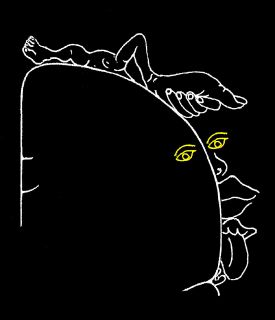 |
|
How can one study the role of the afferent signal from the eye muscles ? It is very difficult to interfere with the sensory signal from the eye muscles (proprioception) in a controlled way. Until recently, the method used to dissociate the proprioceptive input from the oculomotor command in humans involved the application of a suction lens on the sclera to block the eye into a rotated position. Safety concerns obviously limit the use of this method. Following up on the identification of the eye proprioceptive area by invasive recordings in the monkey, my experiments in healthy humans showed that repetitive transcranial magnetic stimulation (rTMS) over the somatosensory cortex alters the perception of one's own eye position and reduces the ability to correct for a proprioceptive perturbation (Balslev and Miall, J Neurosci, 2008). The innovative use of rTMS, which provides a safe and painless method to study the role of the eye position signals in behavior and cognition, was acknowledged with the Young Investigator Award at the University of Oxford/Magstim Summer School in 2010 . This research was funded by a postdoctoral fellowship from the Danish Medical Research Councils.
Eye proprioception impacts on the allocation of attention in space. A consistent observation in my experiments has been that decreasing the excitability of the eye proprioceptive area in the somatosensory cortex also changes stimulus visibility (Balslev, Gowen and Miall, J Cogn Neurosci, 2011, Odoj and Balslev, J Cogn Neurosci, 2013) as well as the activity of the higher-order visual cortex in response to a visual stimulus (Balslev, Siebner, Paulson and Kassuba., Neuroimage, 2012). Furthermore, the same changes in stimulus visibility can be triggered by manipulating the proprioceptive signal in the ocular periphery (Balslev, Newman and Knox, Invest Opthlamology and Vis Science, 2012). These findings are intriguing because the somatosensory cortex is normally not associated with visuospatial attention. Most oculomotor areas such as the frontal eye fields or the superior colliculi however, play a role in both moving the eyes and in moving the locus of attention. I argue that the somatosensory cortex too has such a dual function, in coding eye position and in coding the locus of attention. This explains a counter-intuitive observation: an additional stroke in the somatosensory cortex helps alleviate the lateral attention bias in patients with spatial neglect! (Balslev, Odoj and Karnath, J Neurosci, 2013).
To locate visual objects, the brain relies on the oculomotor command (but only as long as the two eye position signals are congruent).There are two main sources of eye position information. The efference copy of the command issued to the eye muscles or the corollary discharge and the afferent information from these muscles or eye proprioception. A role of the corollary discharge in visual localization has long been presumed because visual localization is intact after sectioning the nerves that brings proprioceptive input from the eye muscles to the brain. Proprioception was believed to play no role in visual localization, but rather update the corollary discharge over days. I had the opportunity to test this hypothesis in a patient with a rare, focal lesion of the somatosensory cortex. The results show that visual localization indeed relies on the corollary discharge. Proprioception however is continuously compared against the corollary discharge, to be incorporated into the eye position estimate as soon as a mismatch between the two signals is detected (Balslev and Miall, J Neurosci, 2008; Balslev et al., J Neurosci, 2012). This finding was the topic of a Young Investigator Talk at the Gordon conference of Eye Movement in 2011 and the paper describing it was awarded an Attempto Prize at the University of Tuebingen. This research was funded by a Marie Curie fellowship for Career Development and a Research Grant from the Danish Medical Research Councils. A mismatch between prediction and re-afference occurs not only during growth or after surgery of the eye muscles in patients with strabismus, but also in everyday life, for instance every time one applies a contact lens. To dissociate the corollary discharge and eye proprioception in the laboratory, I use passive eye movement and repetitive transcranial magnetic stimulation (rTMS) over the eye proprioceptive area. In such conditions with an acute mismatch between the two eye position signals, the abnormal proprioceptive signal can be measured as an error in locating visual objects relative to the body
|
| Figure 2. Hand proprioception affects visuospatial attention (Daniela Balslev, PhD thesis, cover figure by Pauliina Aarnio) | 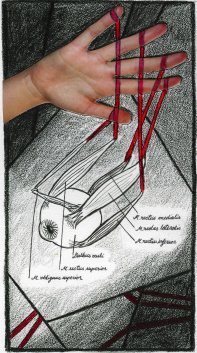 |
|
Hand proprioception and its influence on processing visual information Limb muscles too have receptors that sense stretch. By integrating inflow across receptors it is possible to extract the position of the limb . During my PhD, I have developed a method to silence this inflow in a working muscle in healthy people using repetitive transcranial magnetic stimulation over the hand-contralateral somatosensory cortex (Balslev et al., J. Neurosci 2004). I have been using this method to show that during movements, the proprioceptive feedback facilitates the processing of visual hand feedback (Balslev et al., J Vision 2007) . The mechanism of this effect is presumably the interaction between proprioception and vision in the allocation of attention in space. That is, during movement, proprioceptive stimuli "draw attention" towards the location of the hand facilitating visual perception at that location (Jackson, Miall and Balslev, Exp Brain Res, 2010). This research was funded by a PhD scholarship from the Copenhagen University Hospital, Rigshospitalet. See the publications page for a list of articles and links, or search PubMed or Google Scholar for Daniela Balslev. |